Central China's Hunan province has continued to strengthen its role as a major economic powerhouse, making solid progress in advanced manufacturing and scientific and technological innovation, said Mao Weiming, the province's governor and a deputy to the National People's Congress (NPC), at a meeting of the Hunan delegation during the fourth session of the 14th NPC on Saturday.
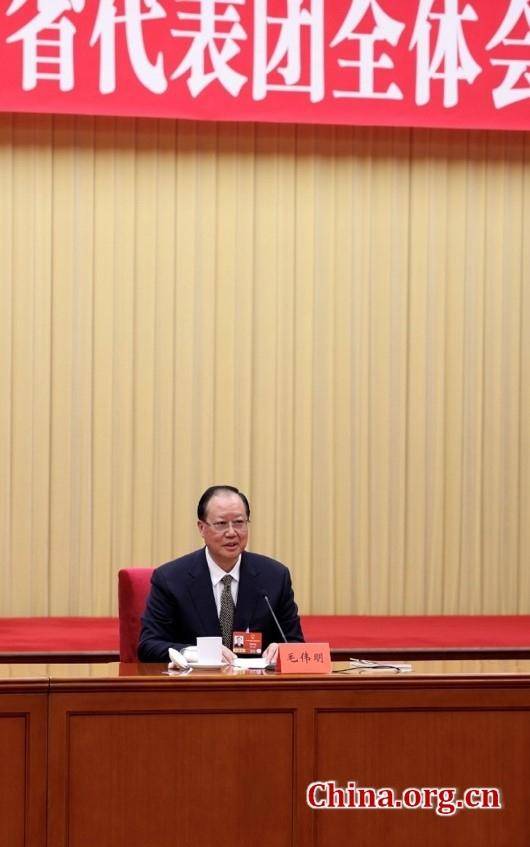
Mao Weiming, governor of central China's Hunan province and a deputy to the National People's Congress (NPC), speaks at a meeting of the Hunan delegation during the fourth session of the 14th NPC on March 7, 2026. [Photo by Niu Fanbing/China.org.cn]
Over the past five years, the province's economic output expanded by more than 1.36 trillion yuan ($197.2 billion), roughly equivalent to the economic size of its capital city, Changsha. Hunan's GDP reached 5.53 trillion yuan in 2025, crossing the 5-trillion-yuan mark during the 14th Five-Year Plan period (2021-2025), Mao said.
Advanced manufacturing has become a key pillar of Hunan's growth. The province has developed five national advanced manufacturing clusters, ranking fifth nationwide and first in central China.
Industrial clusters spanning construction machinery, rail transit equipment, small- and medium-sized aero engines, next-generation secure computing systems and ultra-high-voltage power transmission equipment have all continued to expand, bolstering the high-quality development of Hunan's manufacturing sector.
The province has also made notable progress in the automotive industry. In 2025, Hunan's automobile output reached 1.62 million units, with new energy vehicles accounting for more than 1 million of those.
Technological innovation has also gathered pace. Hunan has continued to advance its sci-tech innovation initiatives and accelerated efforts to build Changsha into a global R&D hub. The province has made breakthroughs in more than 180 key technologies, while its comprehensive innovation capacity ranking climbed from 12th to ninth nationwide, Mao said.

Visitors view a humanoid robot at the 4th International Summit on BeiDou Navigation Satellite System (BDS) Applications in Zhuzhou, central China's Hunan Province, Sept. 24, 2025. [Photo/Xinhua]
Industries built around the BeiDou Navigation Satellite System (BDS) have become a standout feature of Hunan's technological development. The province is home to more than 80% of the country's core BeiDou technology resources, while Zhuzhou, a city in Hunan, has become the permanent venue for the International Summit on BeiDou Applications, Mao added.
Changsha, in particular, has seen rapid progress since launching its global R&D center city initiative in August 2023, said Shen Xiaoming, Party secretary of Hunan province and an NPC deputy.
Since then, the city has added 2,159 R&D institutions, averaging 77.1 new institutions per month — three times the monthly average before the policy was introduced. That includes 816 new institutions in 2024 and another 861 in 2025.
The international profile of Changsha's innovation ecosystem is also growing. Some 590 R&D centers drawing on global resources and serving global markets have been established in Hunan, with industry leaders such as Bosch and Vale among those setting up operations in Changsha.
Changsha's R&D spending intensity has risen from 3.27% in 2023 to 3.36% in 2025, while the number of R&D personnel increased from 103,000 to 123,000. In the 2025 global science cities ranking released by Nature, Changsha ranked 23rd, up 11 places from 34th in 2022, Shen said.
Hunan has also continued to expand high-level opening up. Its trade and economic ties now extend to 235 countries and regions, while 212 Fortune Global 500 companies have invested in the province, Mao said. In 2025, Hunan's trade with Africa reached 58 billion yuan, ranking first among central and western Chinese regions for seven consecutive years.
The private economy has remained a key driver of growth. The sector contributes about 50% of tax revenue, 70% of GDP and more than 90% of technological innovation, urban employment and business entities, Mao said.
At the same time, Hunan has continued to improve infrastructure networks covering transportation, energy, computing and water conservancy. The province's total computing capacity has exceeded 13,000 petaflops, while its supercomputing capacity has reached 228 petaflops, ranking among the country's frontrunners and at an advanced level globally.
Looking ahead, Hunan expects GDP to grow by an average of 5% to 5.5% annually during the 15th Five-Year Plan period (2026-2030), while continuing to play a key role in underpinning the country's overall development, Mao said.


